

This is an edited and expanded version of our talk at the University of Glasgow on July 6, 2026. The angle for the talk is based on three chapters from The Hard Question of Art: Cognitive Futures, which was released with Verso on August 25, 2026. These chapters set out connections between absurdist poetry and (the philosophy of) quantum mechanics. We are grateful to Bilyana Palankasova for the invitation to speak alongside Mathias Arrignon, Emilia Beatriz, Edy Fung, Ana Prendes, and Semiconductor.
The purpose of this talk is to shed some light on, or to discuss, a possible relationship between quantum mechanics and art. A disclaimer, obviously: we are artists, not physicists.
So, what is this about? Art Before Collapse?
This is a thought experiment about a question that may seem a bit lofty at first: can any art exist within the wave function in quantum mechanics, or, before the collapse of the wave function? Thus, can art (in whatever form or shape) exist in quantum-mechanical situations?
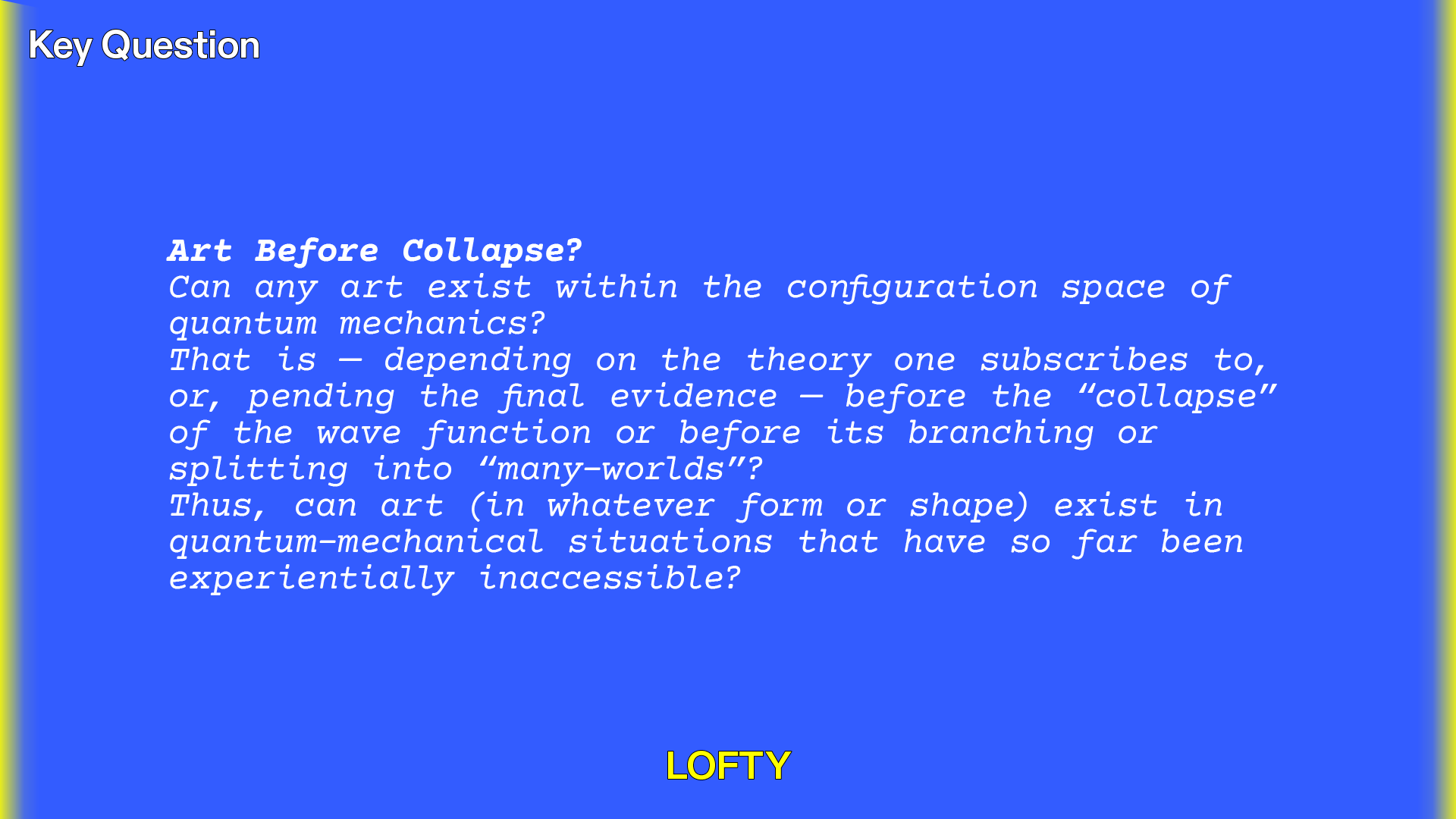
The world in which humans perceive art (and consequently, the one in which artists create it) is mostly classical and macroscopic. The two terms are not equivalent. Macroscopy refers, more or less, to the scale of things we can see with our eyes, whilst classical refers to a set of physics laws (like, for instance, Newton’s laws). So, do macroscopy and the classical laws of physics constitute boundaries beyond which art cannot, or won’t ever, exist? 1
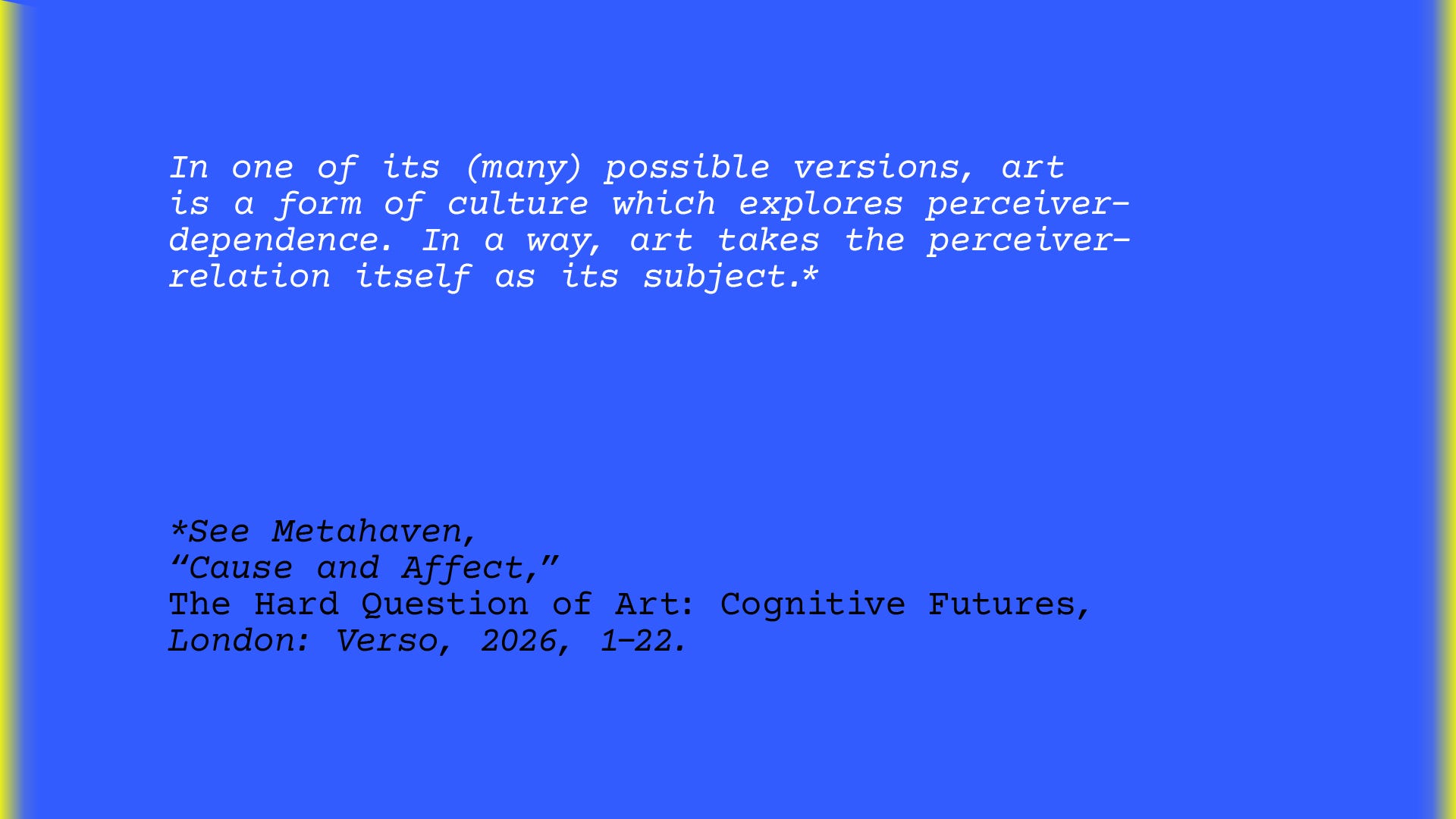
Art as a cultural expression that seeks perceiver-dependence
Our latest book expresses the view that art is a form of culture that structurally explores perceiver-dependence. It is incomplete without perception. So, in a way, art takes the perceiver-relation itself as its subject and central problem.2 If art is a cultural expression that cultivates perceiver-dependence, then bringing it beyond macroscopy and the classical physical laws might be quite a far-reaching extension.
Quantum mechanics and art
Quantum mechanics is the foundational branch of physics that describes nature at the smallest scales of energy and matter. One of its central ideas is wave-particle duality, where entities like light and electrons exhibit both wave-like and particle-like characteristics. While electrons can behave as particles, they also possess wave properties, and light—typically wave-like—can also act as discrete packets of energy called photons. (This is, more or less, the Encyclopedia Britannica entry for quantum mechanics.)3 The quantum world is at once microscopic (as opposed to visible to the eye) and non-classical (as opposed to Newtonian in character).
So, you can make art about quantum mechanics or its discoverers. For example, the author Benjamín Labatut writes a kind of hallucinatory fact-fiction about the scientists who got embroiled with the early development of quantum mechanics.
Or, you can make art with quantum mechanics. For example, the artist Pierre Huyghe, in the monumental film work Liminals (2026), simulated “the oscillation of matter depicted in the film on a 100-qubit Pasqal quantum computer, translating the results into moments in the sound design.” In the film, a faceless and naked human character moves across a vastly dark and barren world surface, approaching some kind of edge beyond which an even bigger nothingness appears to stare at her. Liminals, according to the Berlin-based LAS Art Foundation, is an “allegory” that “explores uncertainty” in order “to reveal a liminal space where states are superimposed. It is analogous to how a quantum system can exist in multiple states before it is measured.” In an interview, Huyghe explains that the central figure of the film is a “human body without any cultural apparatus.”4
This formulation makes sense with regard to what our perceptual systems turn into predictions and, eventually, culturalize. If one accepts that everything is physics, how then about a world in which there is nothing left but physics? That seems to be the kind of world that Liminals shows glimpses of. Yet in keeping with the requirement of being experienced, the work is also a fully macroscopic arrangement.
This talk, then, tries to address a third possibility: can any art exist within quantum-mechanical systems?
Topsy-Turvies
One does not simply walk into quantum mechanics. The detour that brought us there was poetry. More precisely, children’s poems in which impossible situations were being described. These have sometimes been called topsy-turvies. For example, here is one:
In January, on the 5th of April,
In dry weather—with knee-high puddles.
On a brick street—made of wooden planks
Walked a tall man—of short height.5
Consider these poems “adversarial,” mischievous, or at least cute in terms of their truth claims. Because you cannot both be in January and on the fifth of April, right? As parents of a child reading absurdist poems as bedtime stories, the joy of topsy-turvy riddles was visceral for us. Hilarious and adorable, they also hinted at a less predictable world.6 Topsy-turvies always described situations that seemed logically impossible. That is, classically logically impossible: irreconcilable with our intuitive predictions about reality.
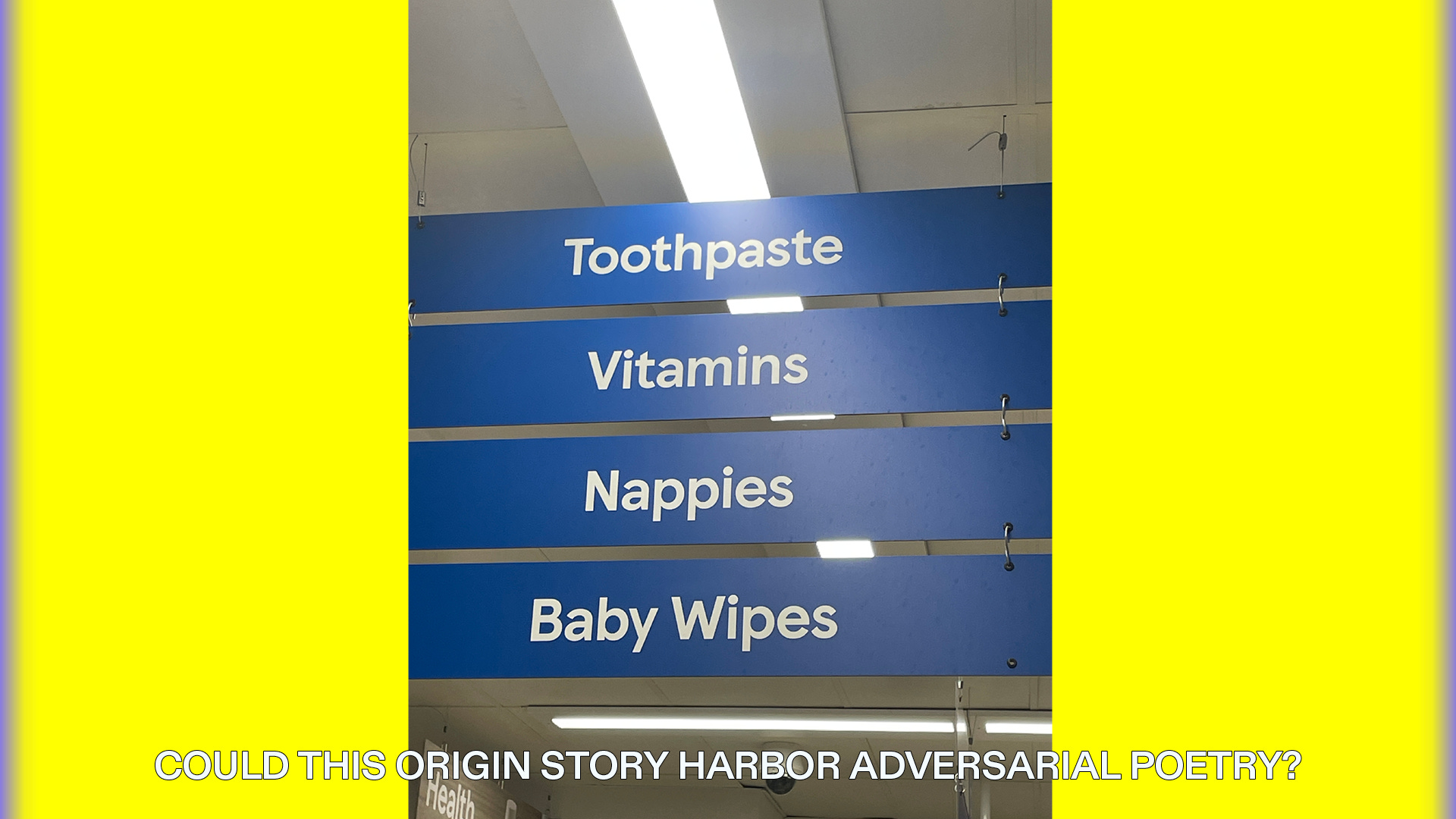
The link with avant-garde poetry
In literary experiments of the early 20th century—and particularly, in the work of the Leningrad poet Alexander Vvedensky (1904–1941)—topsy-turvy approaches were crafted to perfection. In Vvedensky’s poetry, and that of a group of authors he belonged to, ways for language to undercut sense-making and meaning abounded, overturning naming, description, and metaphor. Slowly, Vvedensky went from merely subverting linguistic sense-making to using poetry as a pointer, as a way of questioning if language bears on reality, peeling placeholders and figures of speech from some kind of naked core. And whilst making no mention of science at all, at one point, his writing seemed to refer to quantum states.
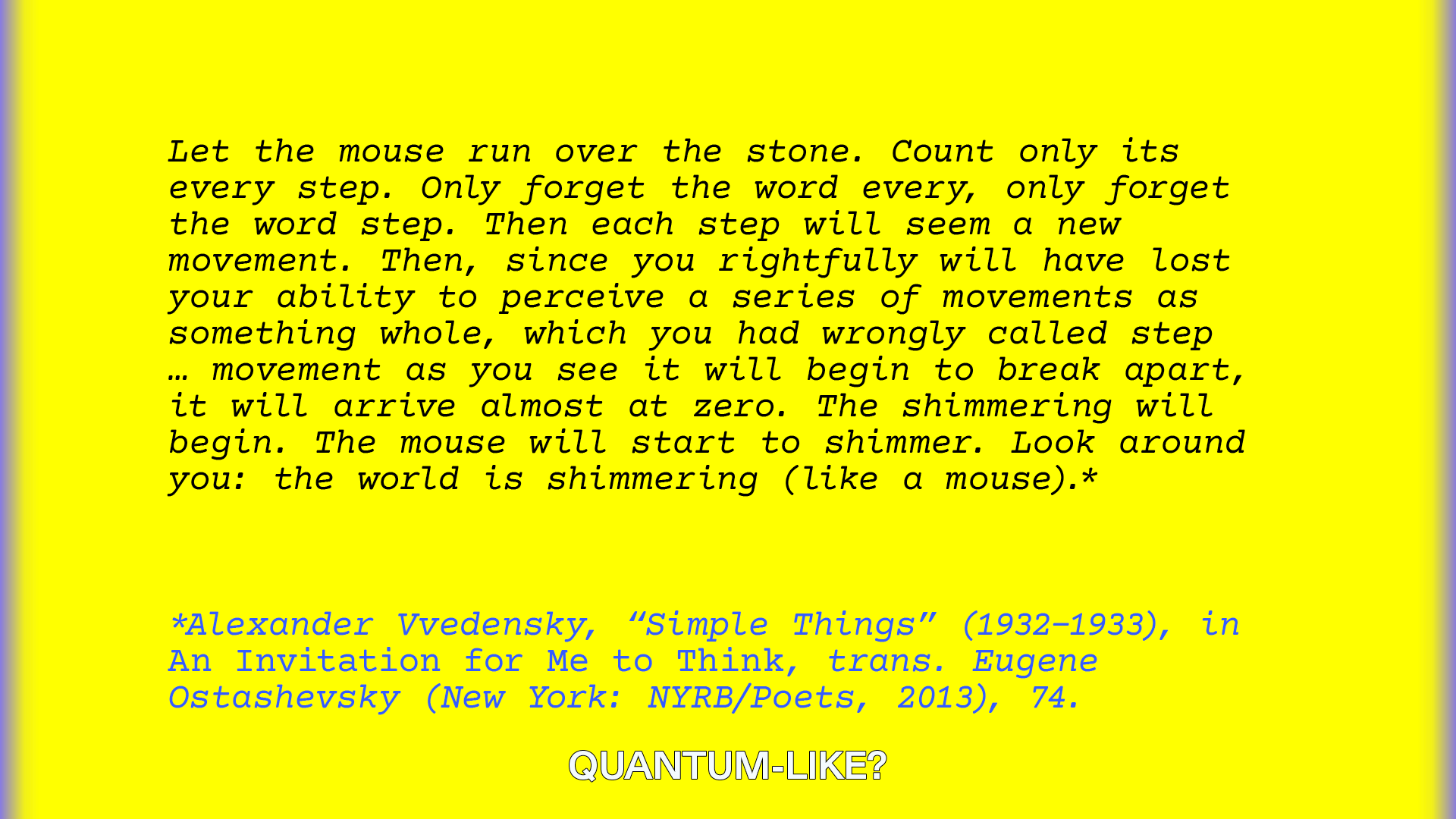
In an early-1930s poem titled “Simple Things,” Vvedensky described a world in a state of “shimmering.” The shimmering began as words for the measurement of time and space—like minute or step—had ceased to refer to something real. As the mouse in the poem starts to shimmer, also, “the world is shimmering (like a mouse).”
With the actual existence of any objects in doubt under the shimmering, one could hardly miss this poem’s proximity to the physical phenomenon of energy arriving in discrete, granular units—or quanta. This was an early 1900s discovery by physicists Max Planck and Albert Einstein that laid the groundwork for quantum mechanics.7 When, in 1933, Vvedensky read in a newspaper that Erwin Schrödinger and Paul Dirac had received the Nobel Prize in Physics, he for once seemed to glimpse a parallel between quantum mechanics and his own poetry.
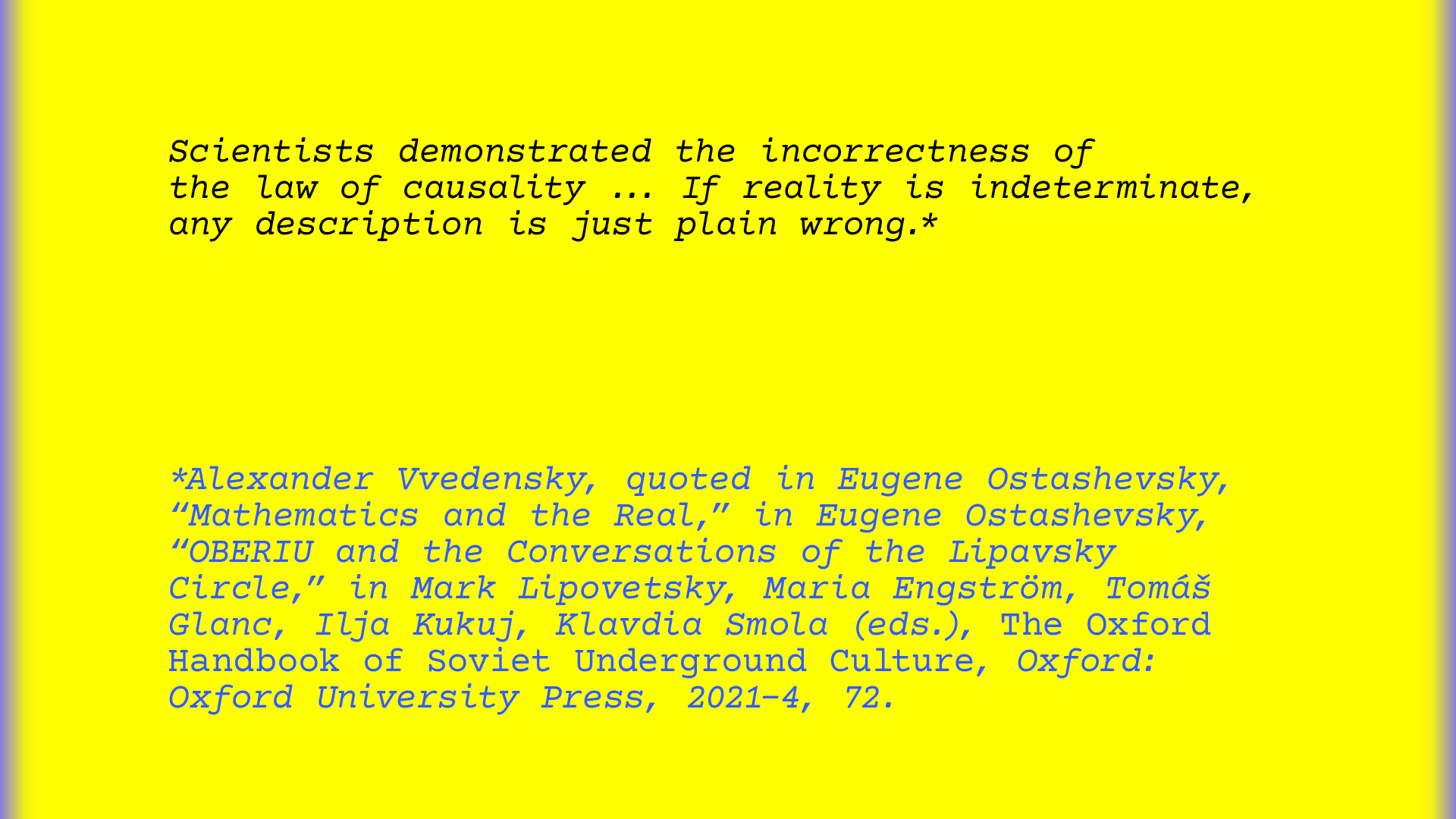
Vvedensky responded that “scientists demonstrated the incorrectness of the law of causality.” He concluded that
if reality is indeterminate, any description is just plain wrong.8
Quantum mechanics showed that counterintuitive foundational states and situations underlie classical reality as it appears to us. One quantum description of foundational reality is Schrödinger’s wave function. In some quantum theories, including the so-called Copenhagen interpretation,9 the collapse of the wave function occurs upon measurement10 or interaction. Upon collapse, reality is observable as a particle system, with each particle having certain given probabilities of being found in state A or B. The wave function keeps the physical system in superposition—in state A and B rather than A or B. In some sense, the collapse “interfaces” between the classical and the quantum world.
Let’s go back to the topsy-turvies for a moment, in which you found a poetic system both “in January” and “on the fifth of April.”
So, if that kind of poem made you laugh, it was—in a way—because it was depicting a superposition. And you were poised to pick one of the two options (A or B) rather than accepting that both could be real at the same time. The basic formula for topsy-turvies was
A puzzle:
Laughed—Solved!11
Then, consider the famous thought experiment of Schrödinger’s cat, which is an allegory for the collapse postulate. It describes a cat in a box, in superposition: it is asleep and awake at the same time. It is the cat (or, reality) as a wave. But Schrödinger’s cat is also, in some way, a poem’s plot. As the box is opened and measurement finds the cat, classically, asleep or awake, our intuitive (and thus, for Vvedensky, “plain wrong”) description is restored.
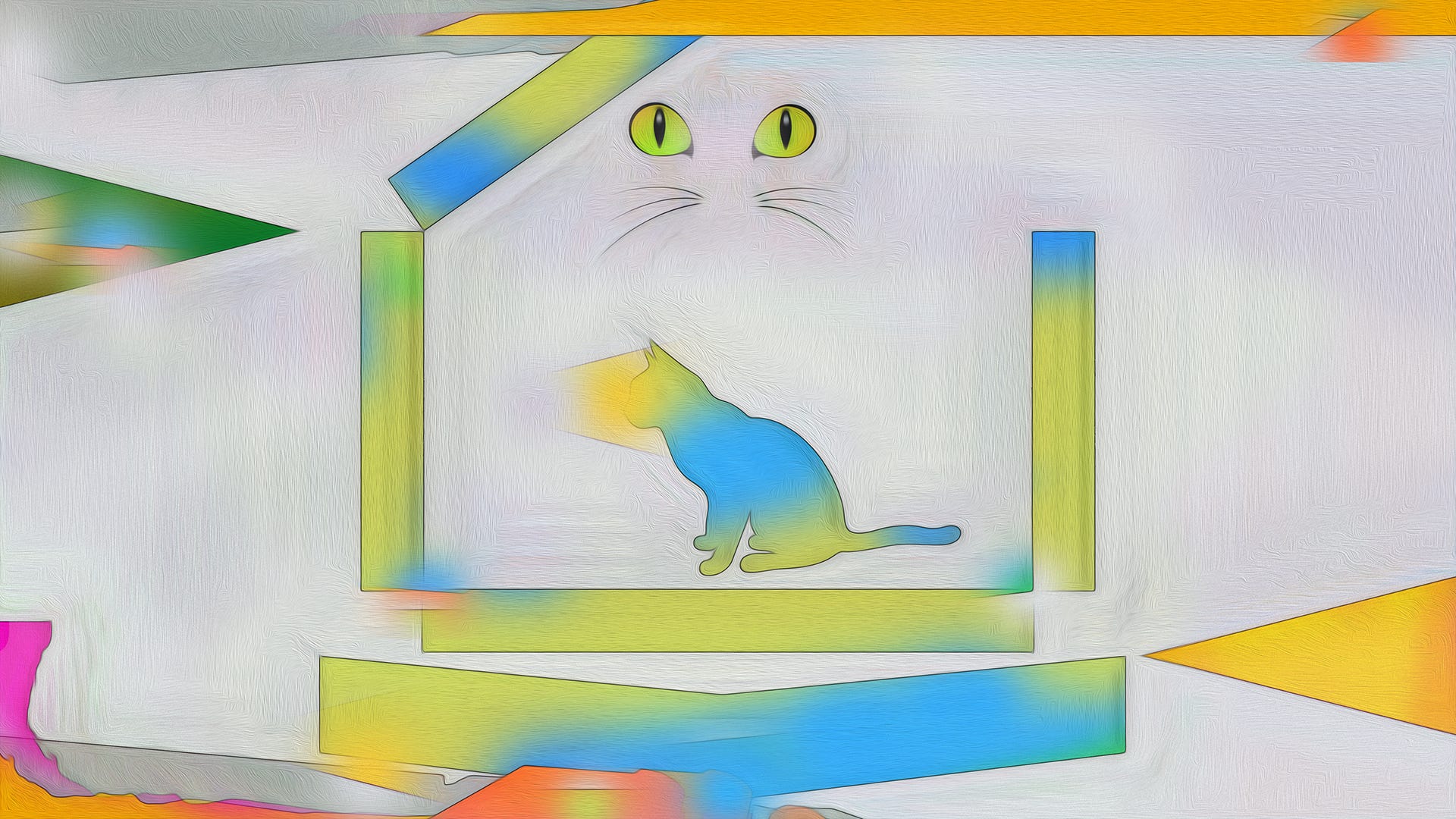
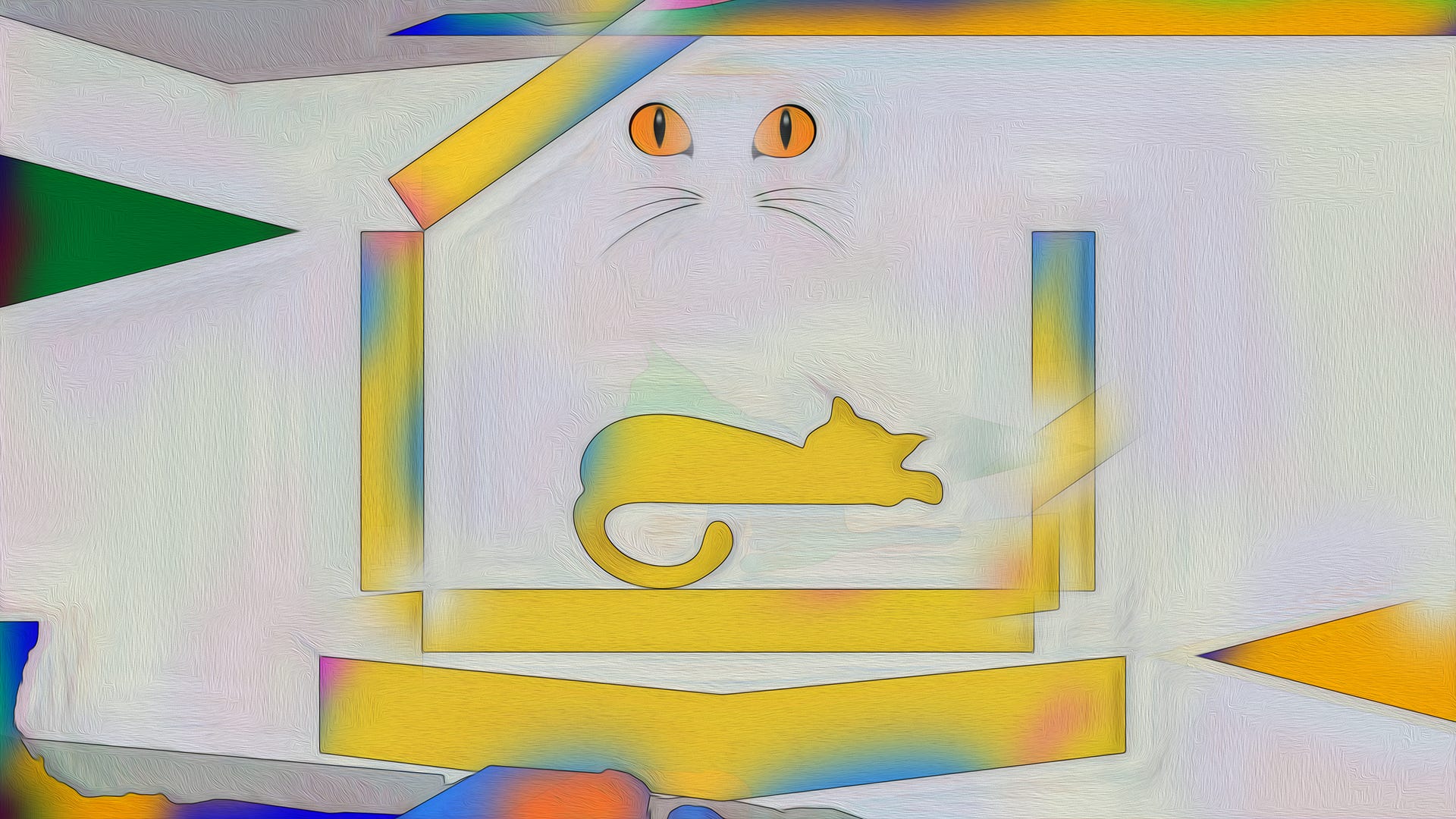
“What is the marital status of the number 5”
How, then, does quantum mechanics intersect with our experience of the world? The work of David Z Albert provides cues to that question. A physicist and philosopher, Albert’s books include Quantum Mechanics and Experience (1994), After Physics (2015), and A Guess at the Riddle (2023).
In 2013, film critic Martha Nochimson asked Albert about superposition. After her suggestion that “particles may be in multiple places at the same time,” Albert replied:
It’s worse than that. It’s putting it poorly to say that they can be in multiple places at the same time. It’s more like this. That [particles] can be in circumstances where asking a question like, Where is the particle now? is what philosophers call a category mistake. It’s like asking a question like what is the marital status of the number 5.12
“The marital status of the number 5” is straight-up topsy turvy poetry. It makes a point about the philosophical implications of the quantum world. We first heard Albert say it on a 2019 episode of the “Mindscape” podcast, hosted by the theoretical physicist Sean Carroll,13 whilst another version of the phrasing occurs much earlier, in Quantum Mechanics and Experience.14 Asking the classical question (about the position of the particle) is asking the wrong question. Asking it affects the quantum information present in the pre-collapse configuration. As Sphinx Svensson put it:
Projective measurements destroy the information being measured to obtain specific data—“are you one thing or not? Do you have this characteristic?”15
“Speakable and Unspeakable in Quantum Mechanics”
Then, let’s take a brief look at theoretical physicist John Stewart Bell’s book, Speakable and Unspeakable in Quantum Mechanics (1987). In the 1960s, Bell had proved nonlocality through his eponymous theorem. Nonlocality—a concept in physics where objects or events separate in space can be connected or correlated instantly, regardless of the distance between them—was yet another aspect through which the quantum description of nature diverged from the classical one.
June Jordan (1936–2002) wrote a short verse about it, “Poem Number Two on Bell’s Theorem, or The New Physicality of Long Distance Love”:
There is no chance that we will fall apart
There is no chance
There are no parts.16
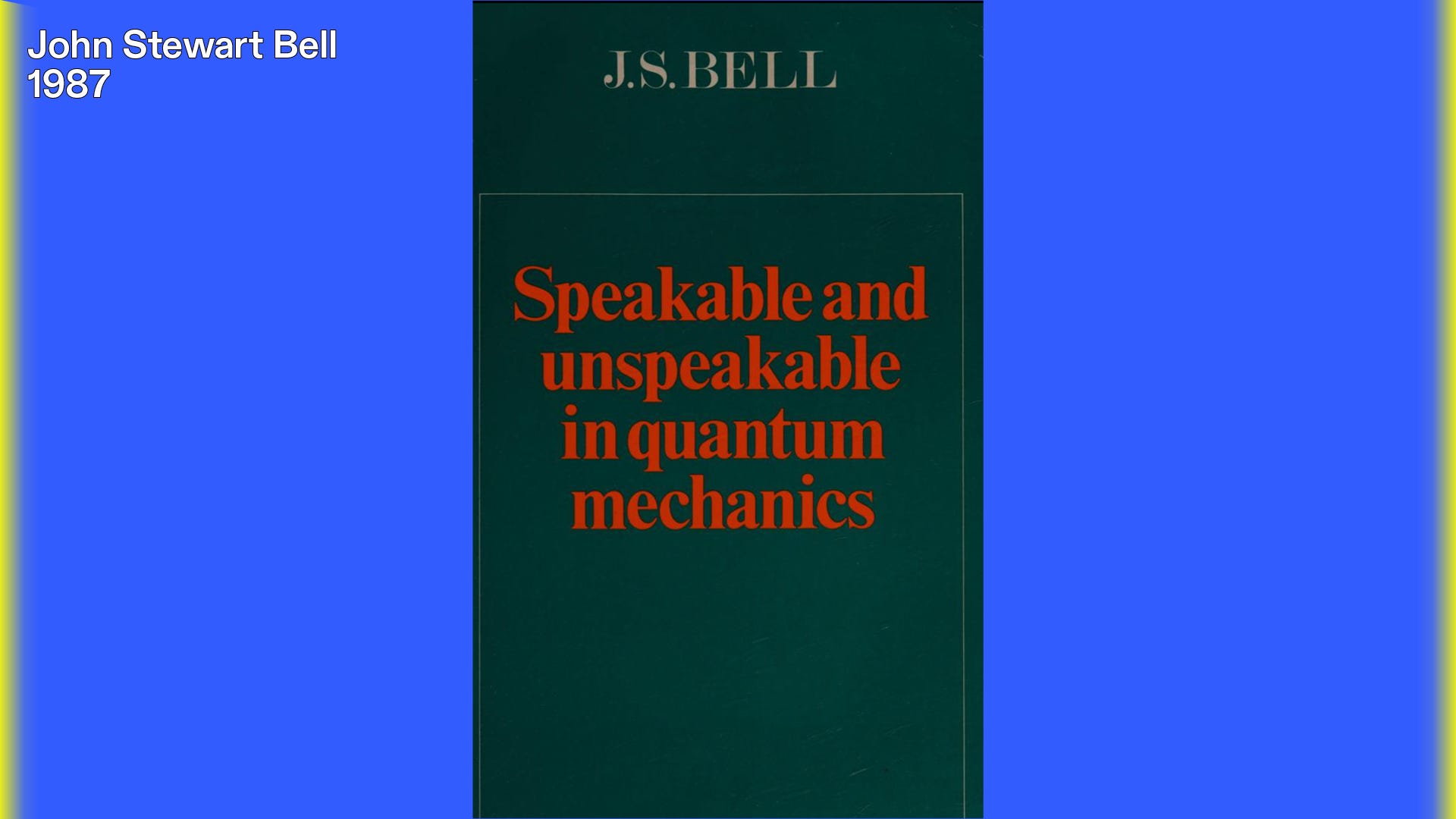
Part of Bell’s Speakable and Unspeakable in Quantum Mechanics was about how quantum mechanics landed in everyday language. He wrote:
The physicists who first came upon such [quantum] phenomena found them so bizarre that they despaired of describing them in terms of ordinary concepts like space and time, position and velocity … No concepts could possibly be found which could permit direct description of the quantum world … It is as if our friends could not find words to tell us about the very strange places where they went on holiday.17
In some sense, then, David Albert appears to be building on the same linguistic discomfort. In After Physics (2015), he takes the reader to problems of narratability that are bound up with quantum-mechanical “families of situations.” Albert proposes to
call a world narratable if the entirety of what there is to say about it can be presented as a single story, if the entirety of what there is to say about it can be presented as a single temporal sequence of instantaneous global physical situations. The possible worlds of Newtonian mechanics can each be presented, in its entirety, by means of a specification of the local physical conditions at every point in a four-dimensional manifold.18
Albert goes on to indicate how there are certain quantum-mechanical worlds exceeding narratability. Our ability to capture them as stories is lagging behind the actual physics. These “non-narratable worlds”19 do not correspond to some of the colloquial—yet deeply engrained—expectations about the world that we’ve come to rely on when telling stories at all. They are beyond what a novel could describe.
Then, might art itself somehow exist “beyond” both its macroscopic and classical boundaries?
The first limit—microscopy—seems the easiest to traverse. It is possible to make really small art. To date, the world’s smallest sculpture is a yellow smiley face measuring 0.01104 x 0.01233 mm. It was made in 2025 by the artist David A. Lindon. In spite of its tiny size the piece functions as if it were macroscopic, sitting safely on the particle side of wave-particle duality. The trickier border is the one with quantum mechanics.
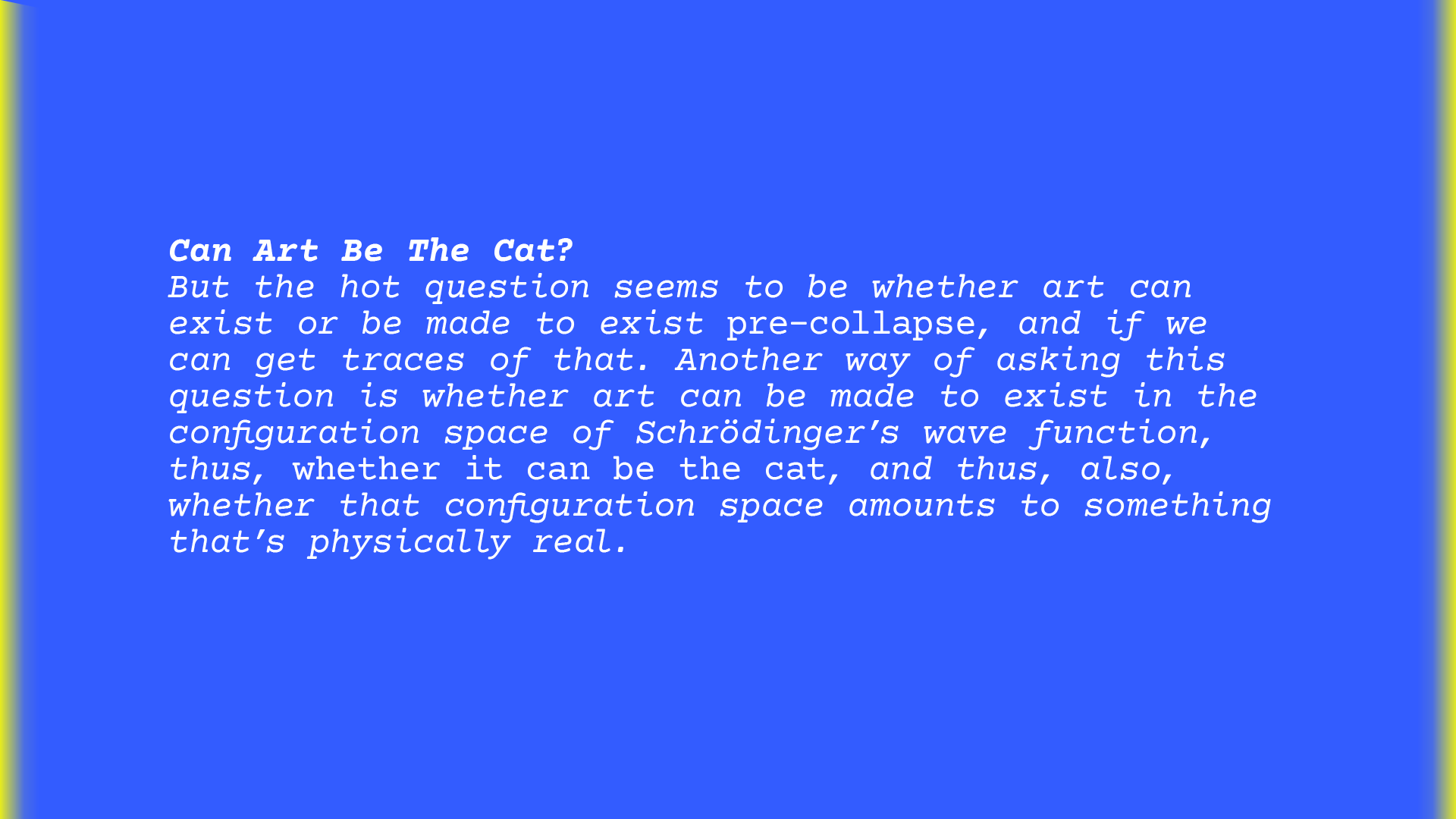
Can art be the cat?
So, the question is whether art can be engineered to exist before the collapse of the wave function. Before measurement makes the cut on the reality that we experience. This question will need to be formulated differently for each of the quantum theories, because some of them do not actually recognize collapse. The hot question, indeed, seems to be whether art can be made to exist as quantum information, and if we can obtain any traces of that information in our classical world. Can art be the cat? Awake and asleep?
Open problems from conceptual art
In the late 1960s, the American conceptual artist Robert Barry created a series of so-called radiation pieces. He would deposit a small radioactive chemical element in an art institution, indicating its presence with a text sign. For example, in 1969, Barry placed URANYL NITRATE (UO2 (NO3)2) in a room on the top floor of the Kunsthalle Bern in Switzerland.
Apparently, they can’t find the piece anymore—even as artist Ines Marita has conducted, and reported on, a thorough search of the venue.20 In an odd way, this (auto)completes Barry’s work. Conceptual art often meant that the work took place in the mind of the perceiver anyway, and that a verbal or written account of its existence overtook direct perception. This was true for a fellow conceptualist, Lawrence Weiner, who claimed that “once you know about a work of mine you own it.”21 For Barry, the radiation emitted by the deposited element constituted a spatial work of “unknown” size and duration. In an interview he claimed to use the unknown “because it’s the occasion for possibilities, and because it’s more real than anything else.”22
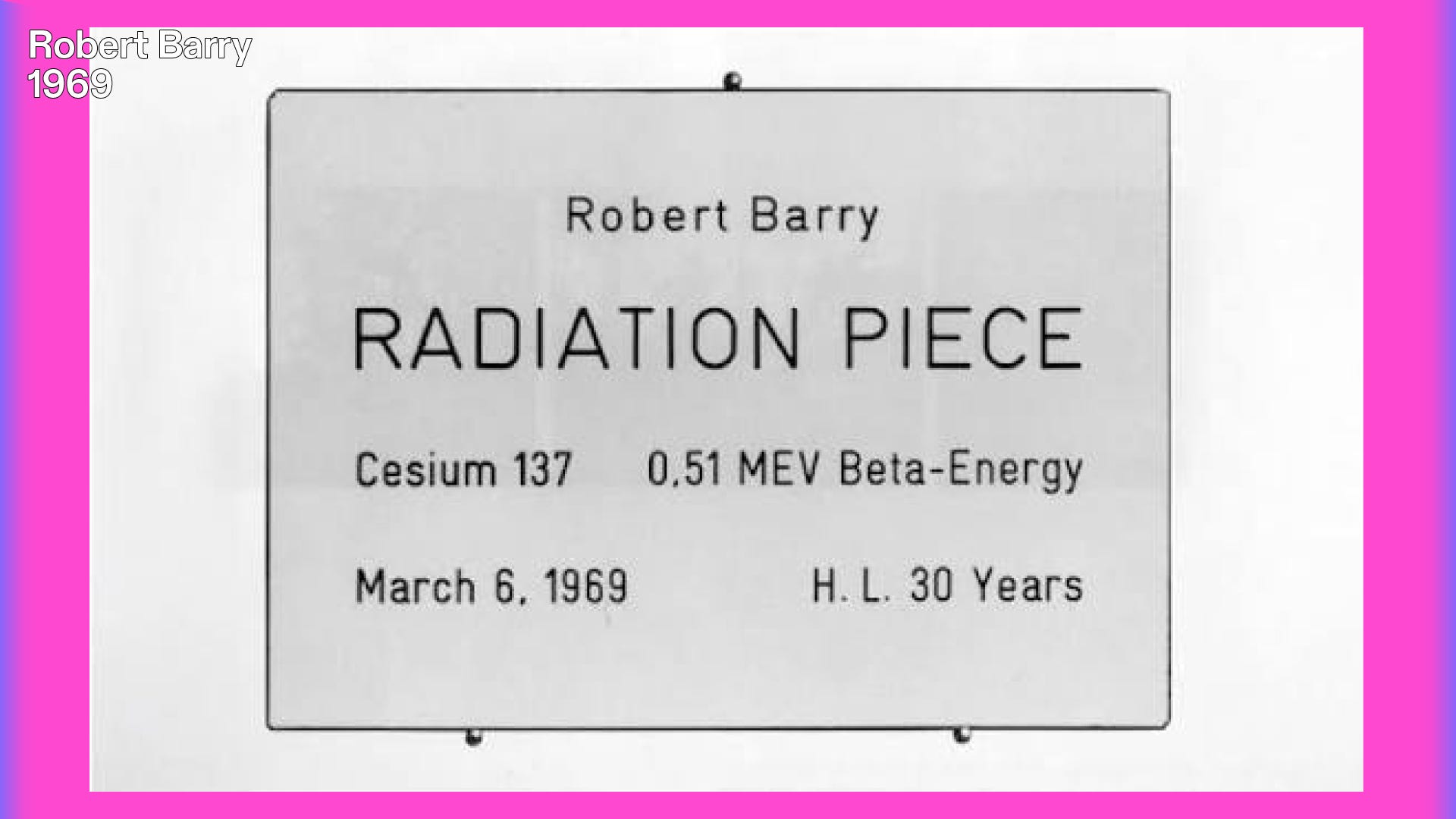
In keeping with conceptual art’s reliance on talk, Barry’s moves were somehow also semiotic in character. The artist pointed at something, declared it art. The walls of the Kunsthalle helped a great deal with making these semiotics happen. Yet in pointing at harder-to-perceive physical objects (like radio waves, cesium elements, but also, forgotten thoughts), some of Barry’s work asked questions about the relationship between art, physics, and experience that remain vital to answer to this day.
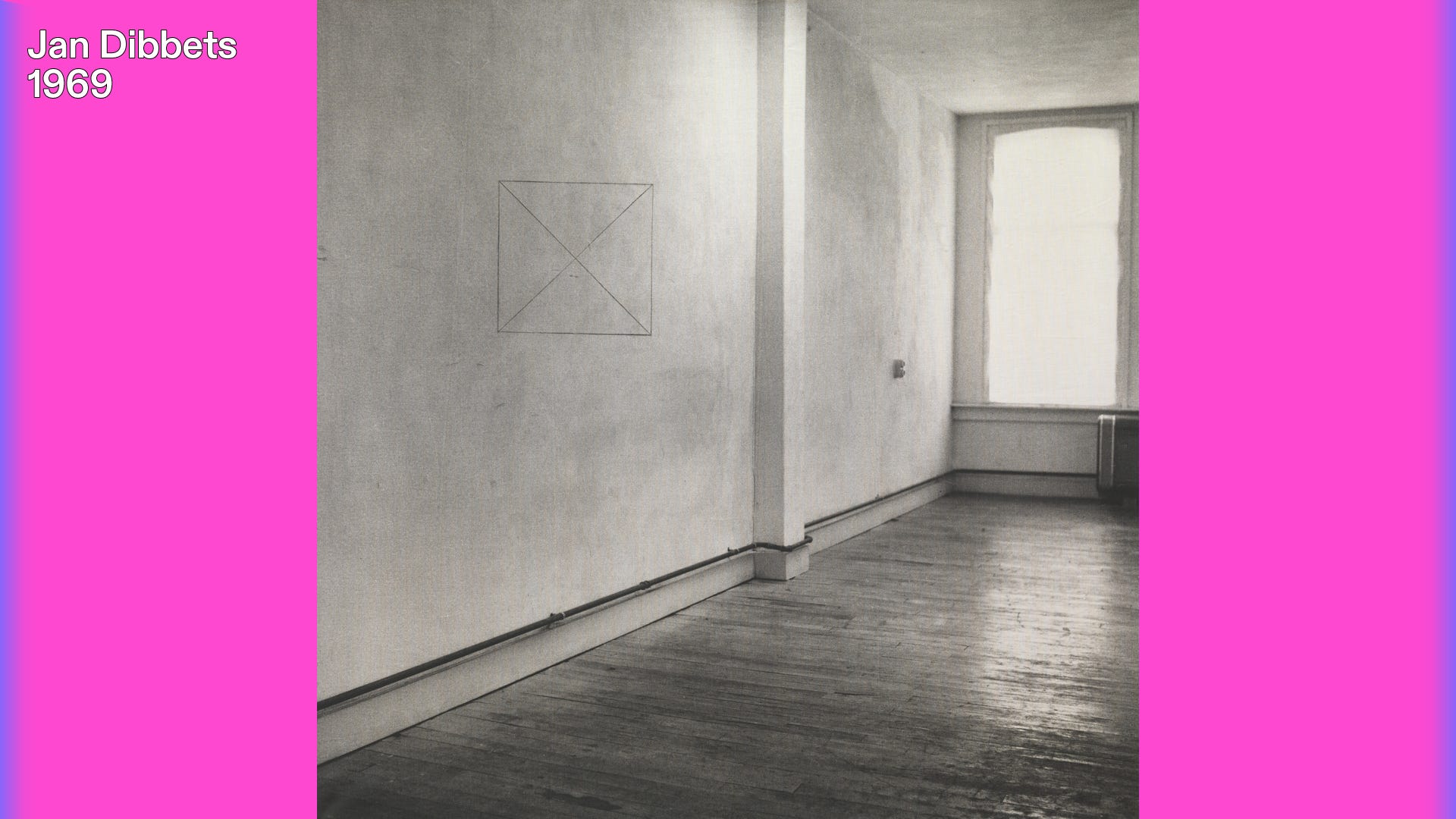
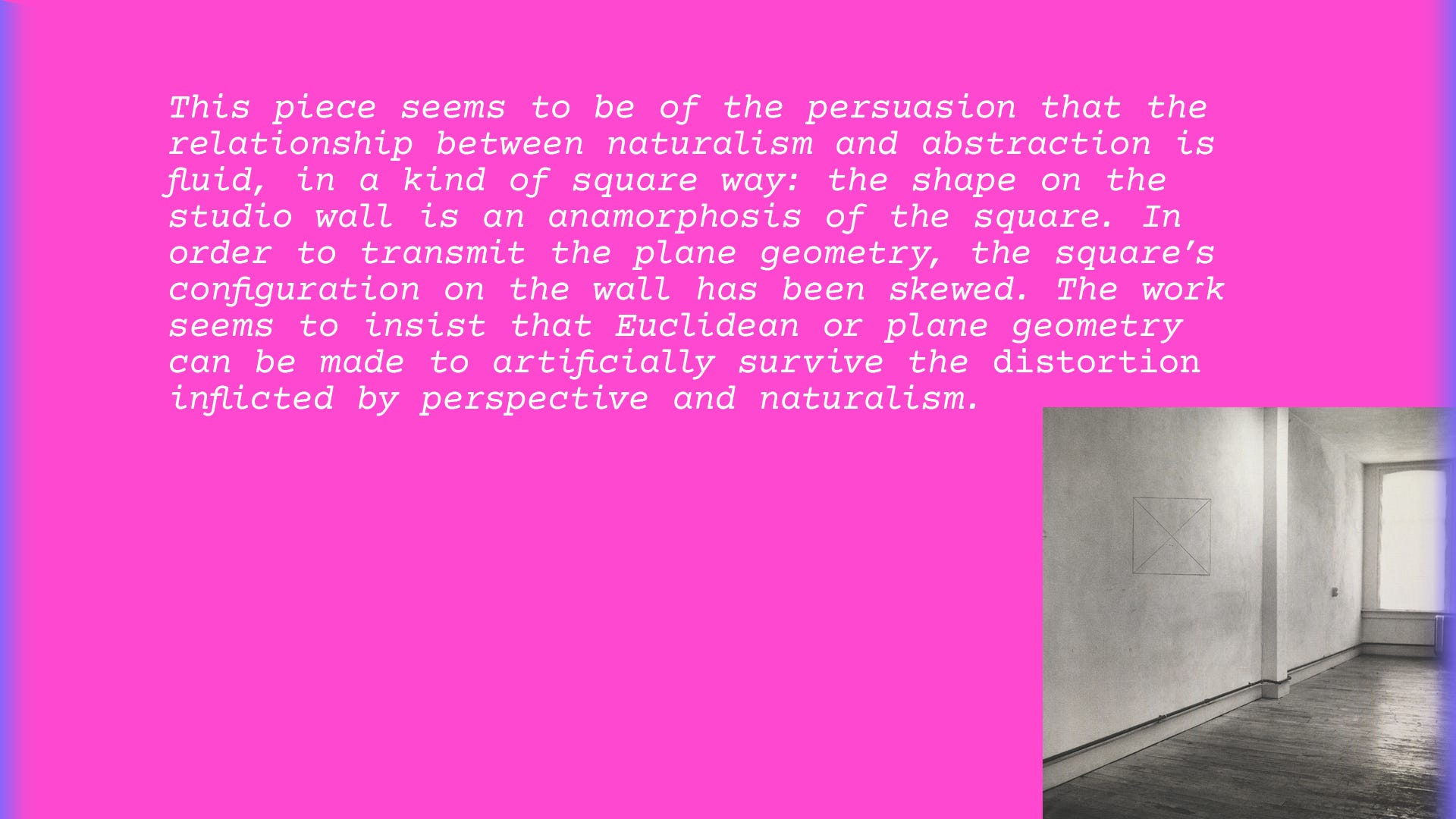
A contemporary of Barry, Dutch artist Jan Dibbets, made photographs of elementary geometrical shapes drawn on his studio wall. One such photograph is Perspective Correction, My Studio I, 2: Square with 2 Diagonals on Wall (1969). The work shows a flat square with two diagonals, seemingly hovering in a studio space. The wall on which it is drawn by the artist is seen under an angle; a cloth-covered studio window is in the background. Dibbets’s piece seems to be of the persuasion that the relationship between naturalism and abstraction is fluid, in a kind of square way: the shape on the studio wall is an anamorphosis of the square. In order to transmit the plane geometry, the square’s configuration on the wall has been skewed. The work seems to insist that Euclidean or plane geometry can be made to artificially survive the distortion inflicted by perspective and naturalism.
Personal and unsettling
So, the type of work that we are proposing here is about constructing, designing, basically, models for art in quantum situations, in quantum-mechanical worlds.
Before we venture further into this, we need to address something that’s central to the urge to do this. And that issue is that the engagement with these worlds feels personal. We cannot see the fundamental particles. We cannot sense them, physically at least. They don’t validate our first-person perspective, our uniqueness as narrators, or our centrality as experiencers. On the contrary: the whole thing feels oddly personal because it’s not doing any of that.
(With hindsight, a work like Nancy Holt’s Sun Tunnels [1973–76]—consisting of four pattern-perforated concrete cylinders in the empty expense of the Utah desert—built something like a minimum viable interface between unmitigated physics and art perception.23 In other words, Sun Tunnels might be the “cultural apparatus” that the protagonist of Huyghe’s Liminals is lacking.)
The overlooked
Physics is personal. Here is a short clip from a film called Capture, which we originally made in 2022. It is in large part built around the video archive of CERN, the European Center for Particle Physics located in Geneva. We were interested in this media archive as a place where certain agents whose presence in science is often overlooked—namely, construction workers, cleaners, engineers—become visible.
And in that respect, it is interesting to look at a short clip about the Super Proton Synchrotron, or SPS, a particle accelerator that preceded CERN’s more famous Large Hadron Collider. The SPS became “the workhorse of CERN’s particle physics programme when it switched on in 1976.”24 So, if you look at a 1970s promotional film about the SPS, you immediately notice a kind of master narrative about what physics is. The fragment, narrated in French, insists on performance, of both collider and particles: length, speed, the distance traveled by the protons.
Following this fragment, Capture’s protagonist (Anita Ricci) says something about the overlooked singing “unheard songs.” As we hear such an unheard song (composed by Espen Sommer Eide) we cut to a video made by a CERN engineer, probably in the early 1990s, coinciding with the arrival of VHS camcorders. It’s a long and un-narrated—no voice or explanation—recording of the door of CERN’s L3 detector, slowly opening and closing.25 Titled “Portrait of a Machine,” the piece was filmed by someone named Michel Lecoq. We know this because he signed the video, handwritten on twice-folded piece of paper shown at the end of the fragment.
Self-narration
Helped by the democratization of camcorders and videotape, this fragment lets us experience a shift toward some kind of decentralized self-narration of science. Lecoq’s filming of the L3 detector door—this giant red sculpture—is arcless and plotless. The camera keeps staring at it as it slowly moves, confronting the materiality of abstraction. The detector is the interface for self-narration by the overlooked.
Bumps in graphs
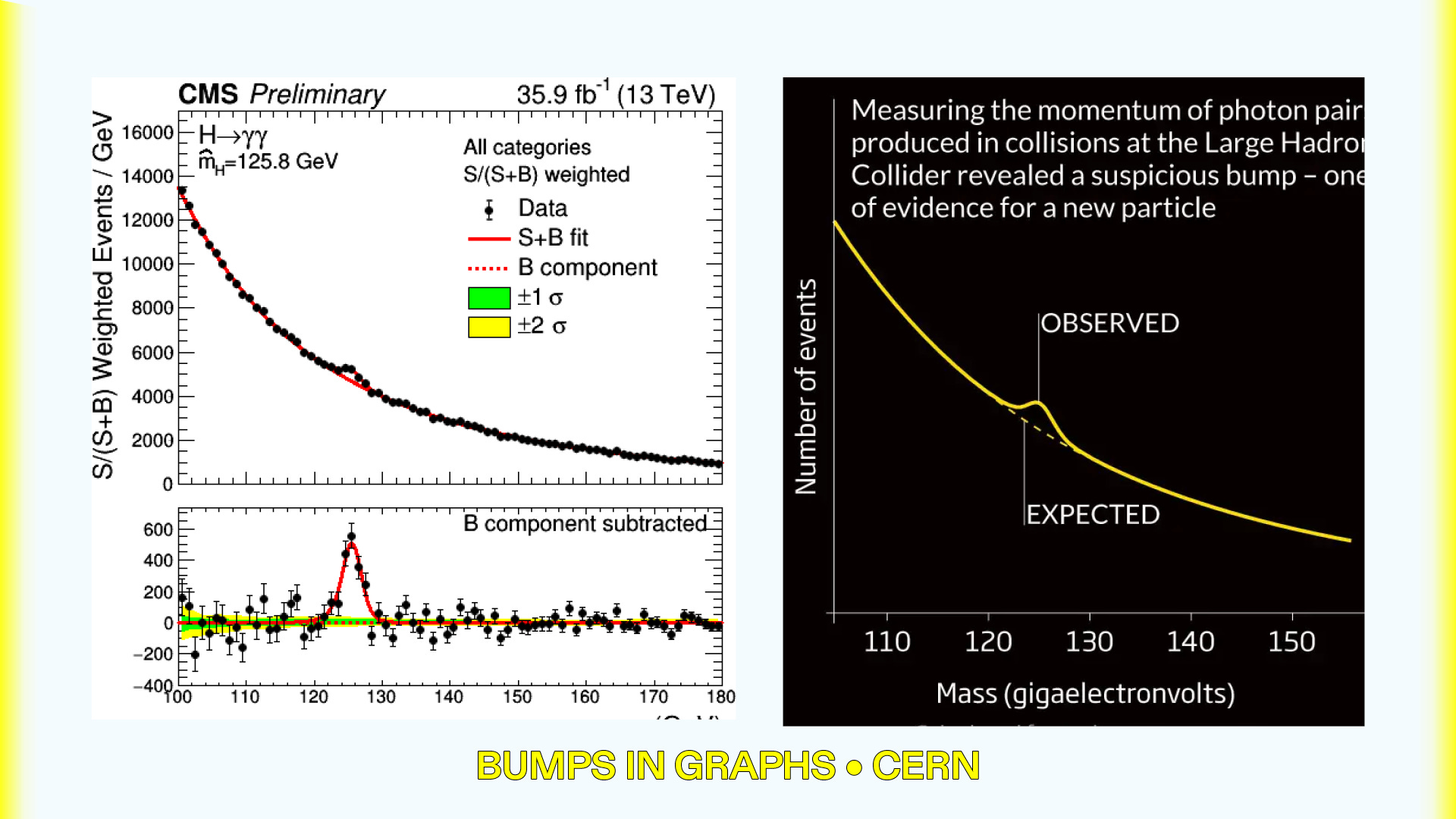
Consider, then, the emotional load of detection graphs, in which, in the Large Hadron Collider at CERN, a tiny anomaly was measured (relative to background) from the accumulated results of about ten million of particle collisions per hour. It’s the Higgs boson saying hi. It is held responsible for the existence of mass, appearing as a statistical entity in macroscopy, standing out like a small elevation from the noise. Yet one can imagine how this kind of bump in a curve is like a painting to a physicist. The overlooked exist.
Can quantum information be art?
“Can quantum information be art” seems to be a concise way of restating the initial question. Since information can be art, there seems to be no sure way to a priori exclude quantum information from being art, too.
One begins to wonder about interfaces between quantum and classical reality that would permit one to design quantum information, and to then obtain macroscopic or classical traces of it.
Are quantum computers these interfaces?
In Glasgow, we said that we thought that quantum computers might be these interfaces. Quantum computers operate upon the quantum world, arranging quantum information, to obtain specific outcomes. It is sometimes uncertain which physical theory prevails for quantum computation, and in some ways foundational questions appear to take the back seat. If indeed, quantum computing “is a domain where experimentalists find themselves ahead of their fellow theorists,”26 what does that mean for anything like a work of art, or a cultural apparatus, to be designed with it?
At the Glasgow talk, there was some pushback from a friendly physicist in the audience. They asked why not use a much more straightforward experimental setup, like, for example, a beam splitter.27 We agree with them: for any pre-collapse art to reveal itself, we should be using the simplest means possible to achieve a proof of concept. At the same time, we’re looking for an apparatus that can design or program quantum information instead of macroscopically demonstrating quantum effects.
Which physical theory prevails?
So, quantum engineering outpaces theory. It appears as if it doesn’t really matter what physical theory of quantum mechanics prevails, as long as the technology itself does.
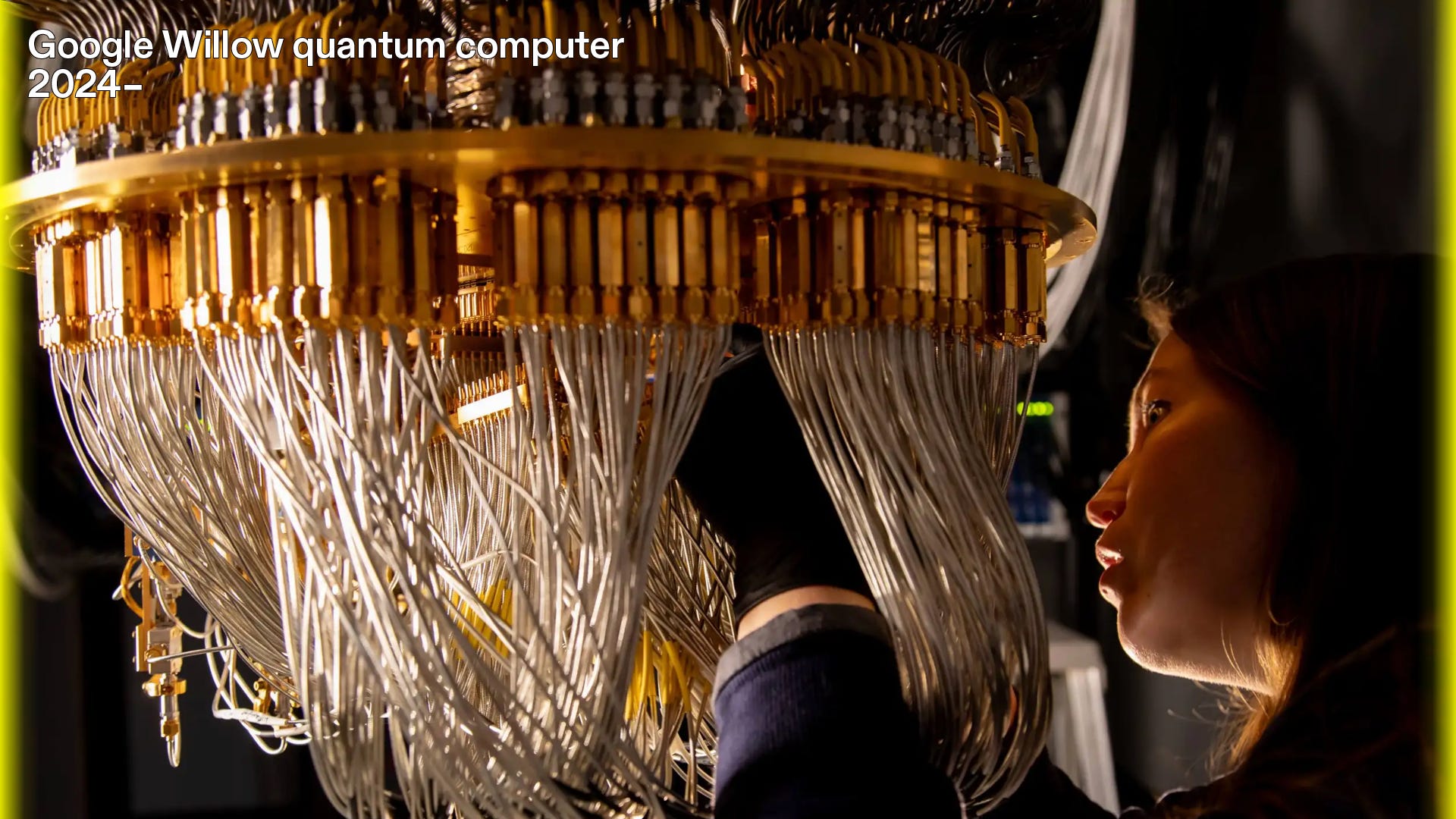
Via late 2024 publications about Google’s cutting-edge quantum chip, Willow, we became acquainted with some of the ideas of its chief architect, Hartmut Neven, about the prevailing physical theory. Neven had set news cycles afire with the offside suggestion that Willow’s computational speed might be due to it making calculations in parallel universes.28
This showed his allegiance to what is known as the Many-Worlds theory of quantum mechanics. The theory was developed in the 1950s by Hugh Everett III. It is seen as a fully-fledged quantum theory, though “MWI”—with “I” for “interpretation”—has come to be its usual acronym.
MWI argues, in short, that Schrödinger’s wave function is continuous and brings about a multiverse of parallel worlds or branches. “We” inhabit but one branch or world of the many that are allegedly realized. We cannot as of now access the other branches experientially or experimentally. So it’s not as if—as is the case in Philip Pullman’s His Dark Materials trilogy (save the abysmal HBO adaptation)—we can “cut” ourselves through the fabric of reality, exiting one version and entering the next, using a knife.
Is the quantum computer’s speed a sign of Many-Worlds being real?
Neven appears to believe that Willow, the quantum computer, does make the cut. In April 2026, he told the Berggruen Institute’s Futurology podcast that he is “in the process of writing a little paper that is titled ‘Evidence for Many-Worlds.’”29 What do we make of this here? One pedestrian question about Many-Worlds has been: where do all these worlds go? But that isn’t the right line of inquiry according to physicists like David Deutsch, who—in his book The Fabric of Reality (1997)—came out an advocate of MWI. As early as the mid-1980s, Deutsch predicted the exceptional speed that quantum computers would have at certain tasks, making the assertion that “the intuitive explanation of these properties places an intolerable strain on all interpretations of quantum theory other than Everett’s.” (And thus, MWI). In the same paper, he suggested that a quantum computer could become the experimental testbed for Many-Worlds. Indeed, he predicted that
the computer’s behavior follows from its having delegated subtasks to copies of itself in other universes. On the days when the computer succeeds in performing two processor-days of computation, how would the conventional interpretations explain the presence of the correct answer? Where was it computed?30
So, a yet-unproven fact (the speed of a quantum computer) was taken to be the future litmus proof for a yet-unproven quantum theory, Many-Worlds. It has a visionary feel to it, yet one runs into questions that are hard to resolve, even (and, in this case, especially) for non-physicists like us. For example, the theoretical physicist Adrian Kent has suggested that quantum information “cannot be copied.”31 If so, can the act of lossless copying—one of the operations that makes classical computation efficient—take place across MWI’s branches? Specifically to the notion of computation in Everettian branches, Kent wrote back in 1987 that “Deutsch assumes that ‘quantum parallel processing’ … will occur during the operation of various computing devices. There is presently no compelling reason for this assumption.”32 Then, in a 2026 paper, “Fundamental Physics, Existential Risks and Human Futures,” Kent notes that
my impression is that in some significant physics research communities (for example string theory and cosmology) Many-Worlds ideas now dominate. It should be stressed though that “the Copenhagen interpretation” and “the Many-Worlds interpretation” have increasingly become umbrella terms, characterizing broad stances about fundamental physics rather than precisely formulated theories. In particular, there are many, many incompatible ideas about what Many-Worlds quantum theory might mean. From time to time I’ve pointed out problems with several of the most prominent, including co-editing a volume where I succeeded, at least, in persuading colleagues to frame the title as a question.33
We embrace question marks and they embrace us back.
So, Art Before Collapse? — A preliminary afterword
Whatever the deepest physical realities of quantum computation and quantum information turn out to be, we place our bets on events of which the true causes are guesswork. And we obtain only traces of these kinds of events in everyday perception. Like, a number that’s been computed by a quantum chip, or an interference pattern that’s ending up on a wall through a double-slit experiment. Dibbets’s square was a perfect trace of a geometrical “event” on his studio wall. Can we get back to art, going down this path, if that studio wall is imagined as a quantum system?
The question—can art exist as quantum information, can art be the cat?—requires a way of engineering, even designing, “art-like” structure as a quantum system. So, what is “art-like structure” anyway? Could you hide, let’s say, “world literature” in quantum information?
The question isn’t whether art can arise within the laws of nature, but whether the laws of nature can allow art to inhabit—by design—a quantum system. Can we, via quantum instruments, come to speak of art arising, emerging in the “non-narratable worlds” of quantum mechanics? Or do those worlds, in turn, present a final boundary for art, a domain where perceiver-dependence (and with it, art) cannot go?
A hypothetical
Anything you would like to propose within a quantum system “as art” would need to include perceiver-dependence; this implies its art quality would need to “emerge”—arise—within a perceptually inaccessible configuration space that has no room for the kind of subjectivity that art is associated with. A very cute kind of Mission Impossible. Art Before Collapse happens through engineered action via a quantum-enabled or quantum-enabling instrument. Engineering it would involve a very strange form of design or poetry. The art needs to emerge within an abstract mathematical configuration space. It probably commits those who are not fluent in the underlying formalism to vibe-coding the hypothetical.
Art Before Collapse hinges on our capacities to engineer quantum information and then obtain a trace. To be continued.
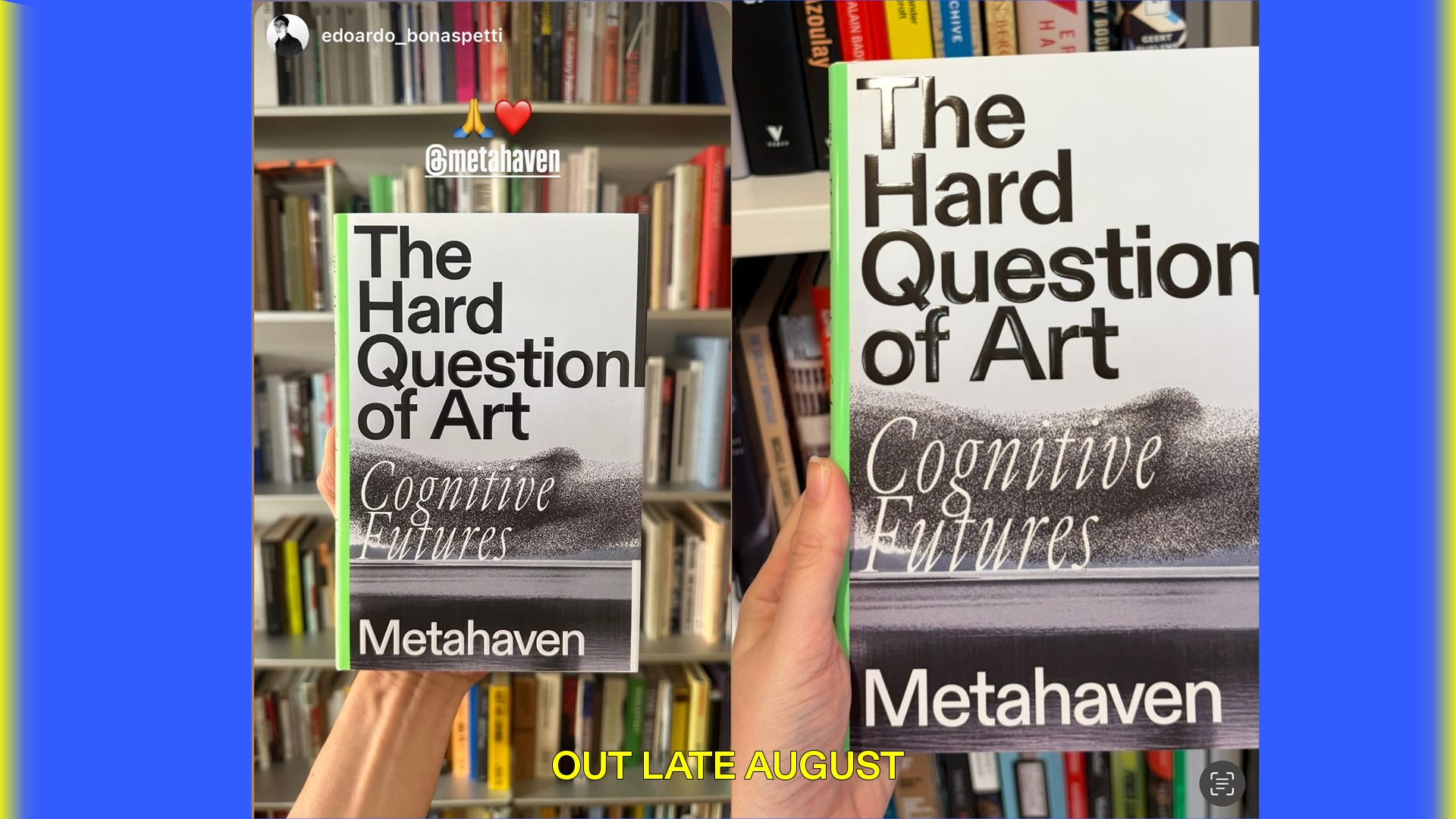
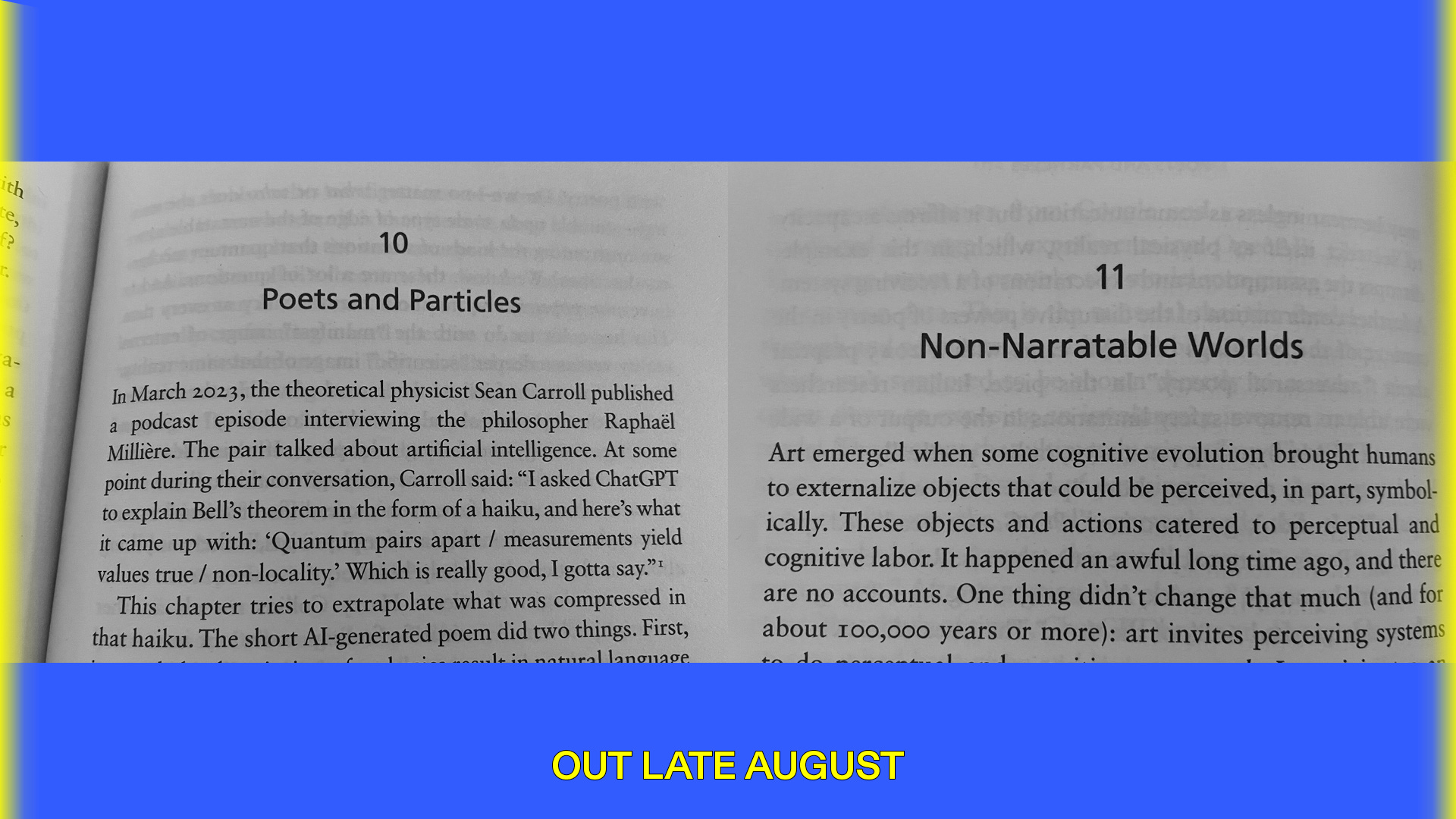
The analogy between art perception and the quantum-mechanical measurement problem is, to us, just that: an analogy. Upon measurement, a quantum system settles on a probability of getting a certain outcome for that measurement. This seems vaguely analogous to a perceiver looking at, hence “measuring” a work of art and settling on an interpretation. But it seems unlikely that these two processes are actually physically equivalent to one another.
See Metahaven, “Cause and Affect,” The Hard Question of Art: Cognitive Futures, London: Verso, 2026, 1–22.
See Pierre Huyghe, Liminals, LAS Art Foundation, 2026.
Alex Anikina, email to author, January 2017. In The Hard Question of Art, 2026, 119.
See Maria Lind: “Metahaven: Art and Other Hard Questions,” Various Artists, August 30, 2022.
It has not been proven that Vvedensky directly used scientific inspiration here. We talk much more about this, and his poetry, in The Hard Question of Art: Cognitive Futures.
Alexander Vvedensky, quoted in Eugene Ostashevsky, “Mathematics and the Real,” in Eugene Ostashevsky, “OBERIU and the Conversations of the Lipavsky Circle,” in Mark Lipovetsky, Maria Engström, Tomáš Glanc, Ilja Kukuj, Klavdia Smola (eds.), The Oxford Handbook of Soviet Underground Culture, Oxford: Oxford University Press, 2021–4, 72.
Whether it is fair to speak of a single “Copenhagen interpretation” appears to be subject of intense debate among physicists. A lot of it focuses on the role of the theoretical physicist Niels Bohr (1885–1962). In a scathing review of Adam Becker’s book, What Is Real? The Unfinished Quest for the Meaning of Quantum Physics (New York: Basic Books, 2018), Blake C. Stacey argues that “there was no single unified ‘Copenhagen interpretation’ worthy of the name.” See Blake C. Stacey, “From Gender to Gleason: The Case of Adam Becker’s What Is Real?,” February 17, 2019.
Specifically on the Copenhagen interpretation’s usage of “measurement,” the latter appears to sit in the way of Copenhagen’s version of quantum mechanics being a “universal theory.” A universal theory, according to the theoretical physicist David Wallace, offers a “self-contained description of the phenomena to which it applies, without the need to appeal to some other theory.” Wallace continues: “Classical mechanics is universal, despite its sharply limited domain, because our classical models of (say) the solar system can be understood without reference to anything beyond themselves; the Copenhagen interpretation is not universal, because we require an external notion of measurement or observation that cannot itself be folded into the quantum formalism.” See David Wallace, “Deutsch’s ‘Quantum theory as a universal physical theory’,” International Journal of Theoretical Physics, September 25, 2023. Online here.
Metahaven, Hometown, 2018, from the film script.
David Z Albert in conversation with Martha Nochimson, 2013. Cited in The Hard Question of Art, 2026, 163. Italics ours.
See Sean Carroll, “Episode 36: David Albert on Quantum Measurement and the Problems with Many-Worlds,” Mindscape podcast, 2019.
The first occurrence of anything of the like in David Z Albert’s written body of work happens in his early 1990s book Quantum Mechanics and Experience, where he writes that “talking or inquiring about the color of and electron” would be “like talking or inquiring about, say, whether or not the number 5 is still a bachelor.”
Sphinx J. Svensson, Three dimensional light fields in atomic state interferometry, University of Glasgow, PhD dissertation, 2025.
June Jordan, “Poem Number Two on Bell’s Theorem, or The New Physicality of Long Distance Love,” cited in Emilia Beatriz’s film Barrunto (2024), which was screened at the symposium with an extensive introduction by Beatriz.
John S. Bell, Speakable and Unspeakable in Quantum Mechanics, 1987. Cited in The Hard Question of Art, 2026, 135-6.
David Z Albert, After Physics, 2015. Cited in The Hard Question of Art, 2026, 164-5.
See Metahaven, “Non-Narratable Worlds,” The Hard Question of Art: Cognitive Futures, 2026, 172.
See Ines Marita, “The Radiation Piece—Chronik einer Suche,” Kunsthalle Bern, 2016.
Robert Barry, interviewed for the exhibition “Prospect 69” at the Städtische Kunsthalle Düsseldorf, 1969, cited in a catalogue with the Kunstmuseum Luzern in 1974.
See Nancy Holt, Sun Tunnels: “The work situates the human body within vast geological and astronomical systems, foregrounding perception as a primary sculptural medium.”
CERN’s L3 detector belonged with the Large Electron-Position collider (or LEP) and began its operations in 1989, more or less coinciding with the democratization of video as consumer tool.
“Quantum Computing,” Stanford Encyclopedia of Philosophy, revision March 5, 2024, at plato.stanford.edu.
Which, among other things, can be involved to demonstrate wave-particle duality.
Hartmut Neven, “Meet Willow, Our State-of-the-Art Quantum Chip,” blog.google, December 9, 2024.
“Welcome to the Multiverse with Google Quantum AI’s Hartmut Neven,” The Futurology Podcast, YouTube, April 22, 2026.
David Deutsch, “Quantum theory, the Church-Turing principle and the universal quantum computer,” Proceedings of the Royal Society of London A 400, pp. 97-117 (1985).